Solar Panels and Your Home Sale: What Every Buyer and Seller in the Western Suburbs Needs to Know
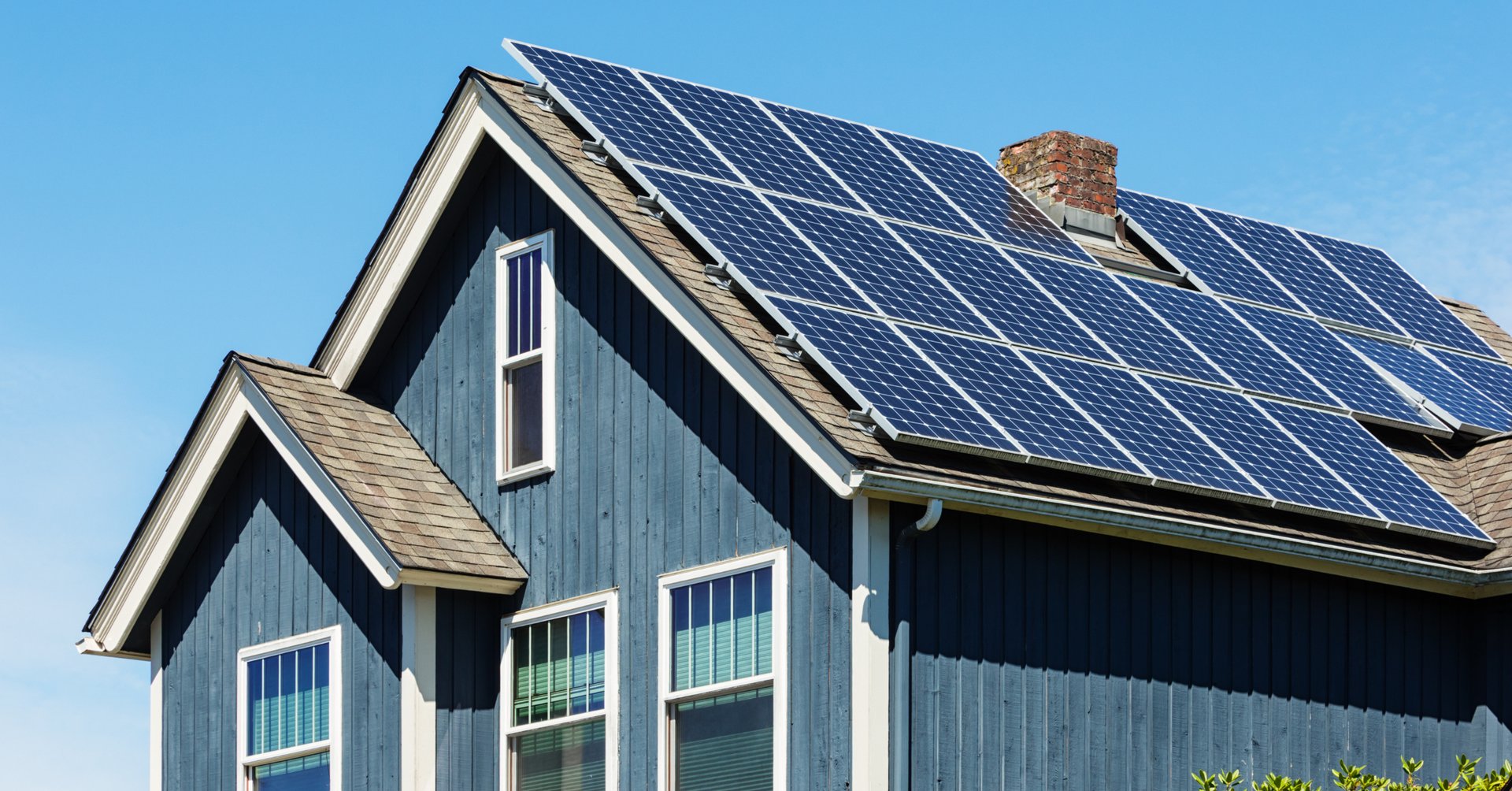
Solar panels are showing up on more and more homes across the western suburbs. Drive through neighborhoods in Downers Grove, Lombard, Bartlett, or Naperville in the $400,000 to $800,000 price range and you will start to notice them on rooftops with increasing regularity. That is not a coincidence. Rising energy costs, environmental awareness, and financing programs that make installation more accessible have all contributed to a steady climb in residential solar adoption. According to a May 2024 announcement from the Solar Energy Industries Association, the U.S. surpassed five million solar installations, with projections to triple that number by 2034.
For buyers and sellers, that means one thing: solar panels are no longer a novelty. They are a real estate consideration that can affect your mortgage qualification, your home's appraised value, your closing timeline, and in some cases, whether a deal gets done at all.
This article is not meant to steer you toward or away from homes with solar. It is meant to make sure you walk into the process with your eyes open, whether you are the one buying or the one selling.
Why Are So Many Homeowners Going Solar?
Before we get into the transaction details, it helps to understand why solar adoption has accelerated. The honest answer is that it is rarely just one reason. Most homeowners who go solar are motivated by a combination of factors:
• Energy costs have risen steadily, and solar offers a way to lock in lower, more predictable monthly payments.
• Environmental consciousness has grown significantly, particularly among millennial and Gen Z buyers who now represent a large share of the market.
• The cost of solar energy has dropped roughly 70% between 2010 and 2023, making installation far more accessible.
• Lease and power purchase agreement (PPA) programs eliminated the large upfront cost entirely, bringing solar within reach for homeowners who would never have paid $20,000 or more out of pocket.
The result is a growing number of homes on the market that come with solar already installed. And that means buyers and sellers both need to understand what they are actually dealing with.
The Three Ways Homeowners Obtain Solar Panels
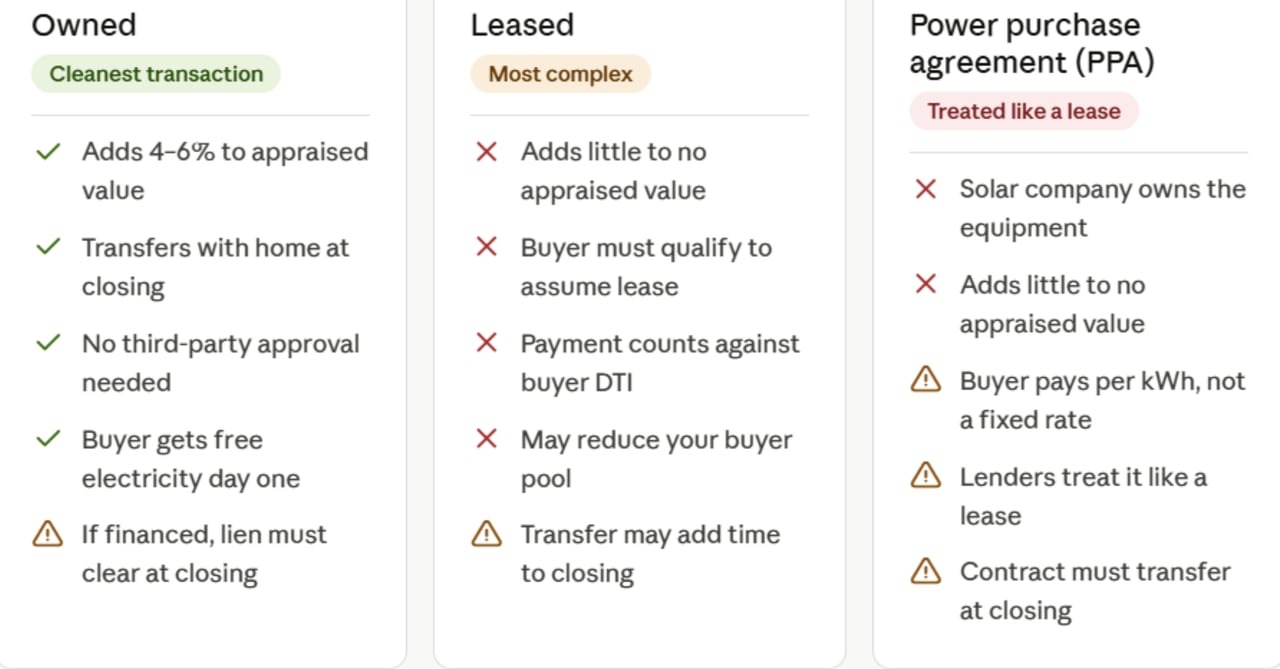
Not all solar panels are created equal from a real estate standpoint. How the system was obtained determines almost everything: the home's appraised value, the buyer's mortgage qualification, the transfer process at closing, and the seller's obligations. There are three common structures:
1. Purchased Outright (Cash or Financing)
When a homeowner pays for the system in cash or finances it through a solar loan, the panels are considered a fixture of the property. They transfer with the home, contribute to the appraised value, and do not require a lease transfer at closing. This is the cleanest outcome for a real estate transaction.
One important note: if the panels were financed, that loan may carry a lien on the property. That lien must be resolved at or before closing. Buyers and their lenders will need to know it exists.
2. Leased Panels
With a solar lease, the homeowner does not own the panels. A solar company owns the equipment and installs it on the roof in exchange for a fixed monthly payment, typically over a 20 to 25 year term. The homeowner gets lower energy costs without the upfront investment.
Leased panels introduce the most complexity in a real estate transaction, and we will cover that in detail below.
3. Power Purchase Agreement (PPA)
A PPA is similar to a lease but slightly different. Instead of paying for the equipment, the homeowner agrees to buy the electricity the panels produce at a set rate per kilowatt-hour. The solar company still owns the equipment. From a mortgage and transaction standpoint, lenders treat a PPA almost identically to a lease. Both require transfer to the new buyer, and both can affect mortgage qualification.
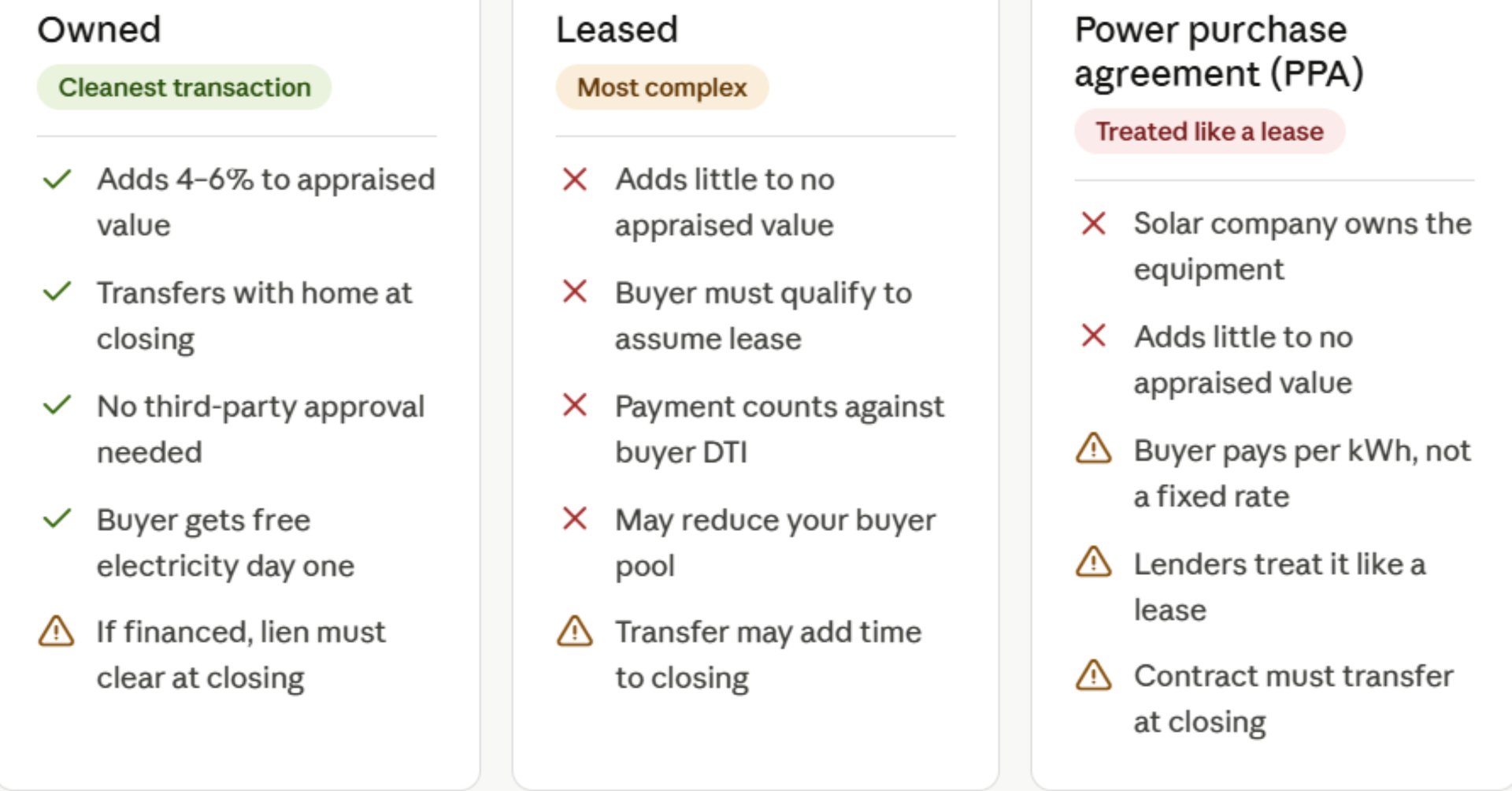
Sources: Freddie Mac guidelines (Aug 2024) · GoMortgage.com · NJ Lenders · NuWatt Energy (2026) | The Tully Team at Platinum Partners Realtors · soldbytully.com
For additional research on how ownership structure affects home value, visit NuWatt Energy’s analysis at nuwattenergy.com/en/blog/solar-panels-home-value
If You Are the Seller: What You Need to Know Before You List

Here is something that comes up more than you might expect. When a purchase offer is being written and the conversation turns to solar, many sellers cannot answer basic questions about their own system. They do not know what they owe on it, how long remains on the lease or loan, what the monthly payment is, or what it would cost to buy out the contract. And a significant number cannot even find the paperwork.
This is not a criticism. Solar contracts are complex, they were often signed years ago, and the details can get buried in a drawer or a forgotten email folder. But when a buyer asks those questions at the offer table and the seller has no answers, it creates uncertainty, and uncertainty is one of the fastest ways to lose a deal.
The Value Question
Sellers with solar panels frequently believe the system adds significant value to their home. Sometimes it does. Research consistently shows that owned solar systems can increase a home's sale price, with premiums ranging from 2.7% to nearly 10% depending on the market. In some regions, owned systems have added upwards of $30,000 in appraised value.
But here is what sellers need to understand: the value added depends almost entirely on ownership. If the panels are leased, appraisers typically do not add value to the home based on their presence. The equipment belongs to the solar company, not the homeowner. A buyer is not purchasing an asset. They are assuming a financial obligation.
I had a buyer who walked away from a property where the seller was firm that the solar panels justified a higher price. My buyer did not see it the same way. The panels were leased, they did not add appraised value, and the seller was not willing to negotiate. The listing eventually sat and was cancelled. The seller's belief in the value of their system, without understanding how lenders and appraisers actually treat leased equipment, cost them the sale.
Lease Transfer: Your Responsibility
If your panels are leased, you cannot simply sell your home and walk away from the contract. The lease must either be transferred to the buyer or bought out. Most leases are designed to be transferred, and in the vast majority of sales, the buyer assumes the lease as part of the transaction. But that process takes time, requires the solar company's approval, and may involve a credit check on the buyer.
Lease transfers may add time to your closing. The process requires the solar company’s approval, coordination between multiple parties, and in some cases a credit check on the buyer. Sellers who do not flag this early can find themselves scrambling at the end. As a realtor, I have also seen leased panels reduce the pool of buyers willing to make an offer. Some buyers simply do not want to deal with the qualification process or the ongoing monthly obligation, and they will move on to the next home. That is a market reality sellers need to factor in when pricing and positioning a home with a leased system.
It is also worth knowing that most leased systems cannot be fully bought out in the first five to six years of the contract due to tax credit rules that govern the solar company’s ownership. If you are in that window and a buyer refuses the lease, your options are limited.
If you are outside that window, it may be worth investigating a lease buyout before you list. Buying out the lease and converting to ownership often adds more value to the sale than the buyout cost. Contact your solar provider for a current buyout quote before you price your home.
Disclosure Is Not Optional
Sellers are generally required to disclose solar agreements, financing terms, and any liens associated with the system. If your panels were financed and there is a lien on the title, that must come off at closing. Many solar companies file what is called a UCC-1 filing against the property to protect their equipment interest. Title companies will flag this and it must be resolved. Failing to disclose a solar obligation is not just a negotiating problem. It can create legal exposure.
If You Are the Buyer: What You Need to Ask Before You Write an Offer
Some buyers see solar panels and immediately get nervous. That reaction is understandable, but it is not always warranted. Owned panels, in particular, can be a genuine benefit: lower utility bills from day one, potential added value, and no monthly lease obligation. The key is knowing what you are walking into before you make an offer, not after.
How Solar Panels Affect Your Mortgage Qualification
This is where buyers get caught off guard more than anywhere else. If the home you are buying has leased solar panels and you are assuming that lease, the monthly lease payment will in most cases be counted against your debt-to-income ratio (DTI). That is the calculation lenders use to determine how much you can borrow.
Conventional loans typically have a DTI cap around 45%, and FHA loans, while more flexible, still count the solar payment as debt. A lease payment that pushes your DTI over the limit can reduce the mortgage amount you qualify for, or in some cases prevent you from qualifying at all.
There is one nuance worth knowing. If the lease includes a production guarantee, meaning the solar company promises the panels will generate a certain amount of electricity and will refund you if they fall short, some lenders will not count that payment against your DTI. Without a production guarantee, the payment almost always counts. Your loan officer needs to know about the solar lease before you write the offer, not at the appraisal stage.
If the panels were financed by the seller, that loan carries a lien on the property. Fannie Mae, Freddie Mac, the FHA, and the VA all have specific guidelines requiring that lien to be addressed before or at closing. Your lender and title company need to identify it early.
The Roof Question Nobody Thinks to Ask
This one matters, and it rarely gets asked until it is too late.
I had a buyer who wrote an offer on a home with solar panels. During the inspection, the inspector found an active roof leak at the panel mounting points, with moisture readings confirming water intrusion beneath the surface. The solar company came out and claimed they had fixed it. The inspector's moisture reader said otherwise. My buyer walked.
Here is the issue that transaction exposed. When a roof needs repair or replacement on a home with solar panels, the panels have to come off first. That is a specialized process that requires a licensed electrician to disconnect the system from the grid, followed by solar installers removing the panels and racking. The cost to remove and reinstall a typical residential system ranges from approximately $1,500 to $6,000 or more depending on system size and complexity. If the panels are leased, the solar company controls that process. If they are owned, the homeowner bears the cost.
There is also a warranty consideration. Removing panels can void the manufacturer's warranty on the equipment. And if the original installer is no longer in business, finding a qualified contractor to do the removal and reinstallation can be a challenge.
The practical takeaway is this: before you write an offer on a home with solar panels, look at the roof carefully. How old is it? How old are the panels? Asphalt shingles typically last 20 to 25 years. Solar panels can last 30 years or more. That lifespan mismatch means most homeowners will face at least one roof replacement during the life of the panels. You want to know where you stand before that becomes your problem.
The Appraisal and Value Picture
Owned solar panels are generally treated as a fixture of the property and can increase the appraised value, though the increase does not always equal what the seller paid for the system. Leased panels, on the other hand, are not included in the home's valuation by appraisers because the buyer is not acquiring an asset. They are taking on a contractual obligation.
Lenders also require that the home have a secondary source of electricity. Solar panels alone cannot be the only power source. Fannie Mae, Freddie Mac, FHA, and VA guidelines all require a grid connection backup. If a home relies solely on solar, it will not meet standard lending requirements.
The Good News: Solar Transactions Are Getting More Common and More Manageable
None of what is outlined above means you should avoid homes with solar panels. It means you should approach them informed.
As solar becomes more common, real estate agents, lenders, and title companies are becoming more experienced with these transactions. Lease transfers are increasingly routine. Lenders understand the guidelines. The process has gotten smoother.
For buyers, a home with owned solar panels can mean immediate monthly savings on utilities, potential added value, and a feature that appeals to future buyers down the road. Research from 2025 shows that homes with owned solar systems sell faster and at higher premiums than comparable homes without them.
For sellers, being prepared before you list means the solar conversation at the offer table does not catch anyone off guard. Know your contract. Know your payoff or transfer terms. Have your paperwork. That preparation is the difference between a smooth transaction and a cancelled listing.
Want the Full Checklist?
Whether you are buying or selling a home with solar panels, there are specific questions you need to be asking, and specific documents you need to have in hand, before any offer is written.
I put together a free Solar Panel Buyer and Seller Checklist that walks through exactly what to gather, what to ask, and what to watch for at every stage of the transaction. It is the same framework I use with my own clients.
Reach out directly to get your copy. Call or text 630.435.3585, email through soldbytully.com, or send a message and I will get it to you right away.
Disclaimer
The information in this article is intended for general educational purposes only and does not constitute professional legal, financial, or mortgage advice. Every real estate transaction is unique. Please engage a qualified lender, attorney, or financial professional for evaluation of your particular situation before making any decisions.
About Shanon Tully

Shanon Tully is a licensed real estate broker and team leader of The Tully Team at Platinum Partners Realtors, specializing in Downers Grove and the surrounding western Chicago suburbs including Lombard, Bartlett, Burr Ridge, and Naperville. A seven-time Five Star Professional Award winner, Shanon brings deep community knowledge and a straightforward approach to every transaction. Learn more at soldbytully.com or call 630.435.3585.
Sources
Solar Energy Industries Association (SEIA): America Exceeds Five Million Solar Installations Nationwide, May 2024. seia.org/news/5million/
U.S. Department of Energy / IRENA: Quarterly Solar Industry Update, Fall 2024. energy.gov/cmei/systems/quarterly-solar-industry-update
Solar Energy World (March 2026): Federal residential clean energy credit (Section 25D) expired December 31, 2025
Lighter Side of Real Estate (January 2026): Leased solar panels and DTI mortgage qualification impact
IQ Rate Mortgages (February 2026): Conventional and FHA DTI caps and solar lease treatment
GoMortgage.com (September 2025): Fannie Mae and FHA guidelines for solar panel properties
EnergySage: Solar panel removal and reinstallation cost range $1,500 to $6,000+
SolarTechOnline (February 2026): Owned solar home sale premium and leased vs. owned impact on home value. solartechonline.com/blog/do-solar-panels-add-value-to-home-guide/
NuWatt Energy (2026): Owned vs. leased solar impact on home value, lease buyout considerations. nuwattenergy.com/en/blog/solar-panels-home-value
SolarInsure Research Analysis (January 2026): Homes with owned solar panels sold for 5-10% more than comparable homes. solarinsure.com/solar-panels-home-values-a-research-analysis
SEIA President Abigail Ross Hopper projection: 15 million U.S. solar homes by 2034